
If your house is not tied into the public sewage line, you most likely have–or are planning to install–a septic treatment system. To properly manage on-site wastewater, it helps to first understand some of the fundamental mechanical components and processes. Septic systems (also known by various regional terms such as residential wastewater treatment, subsurface sewage disposal systems, etc) come in two basic types: Conventional and Advanced. I’ll walk you through the very basics here, but first? Perhaps best to step away from your coffee and croissant. And second? Remember that I am not a professional. This guide is intended to help you ask informed questions of local professionals and perhaps to better understand their responses.
A Conventional Septic System works by first collecting wastewater in an underground tank(s). This includes water from all toilets and drains in-house and on-property. While in this tank, the sewage separates naturally: the solids (called sludge) sink to the bottom; fats (called scum) float to the top; and liquids (called blackwater from toilets and greywater from all other drains) settle in the middle. Over time, as more sewage enters the tank, those middle liquids are displaced. They exit through a filter to prevent any escaping solids and are passed through a distribution box (called a d-box) that manages their paced delivery to a drainage field (called a leach field). There, perforated pipes allow the entering water to slowly seep into a layer of buried gravel. From there, it encounters natural bacteria breaking down any remaining contaminants before the water ultimately percolates through its final filtration system, the native soil. Whatever liquids remain after this step combine naturally with the local groundwater.
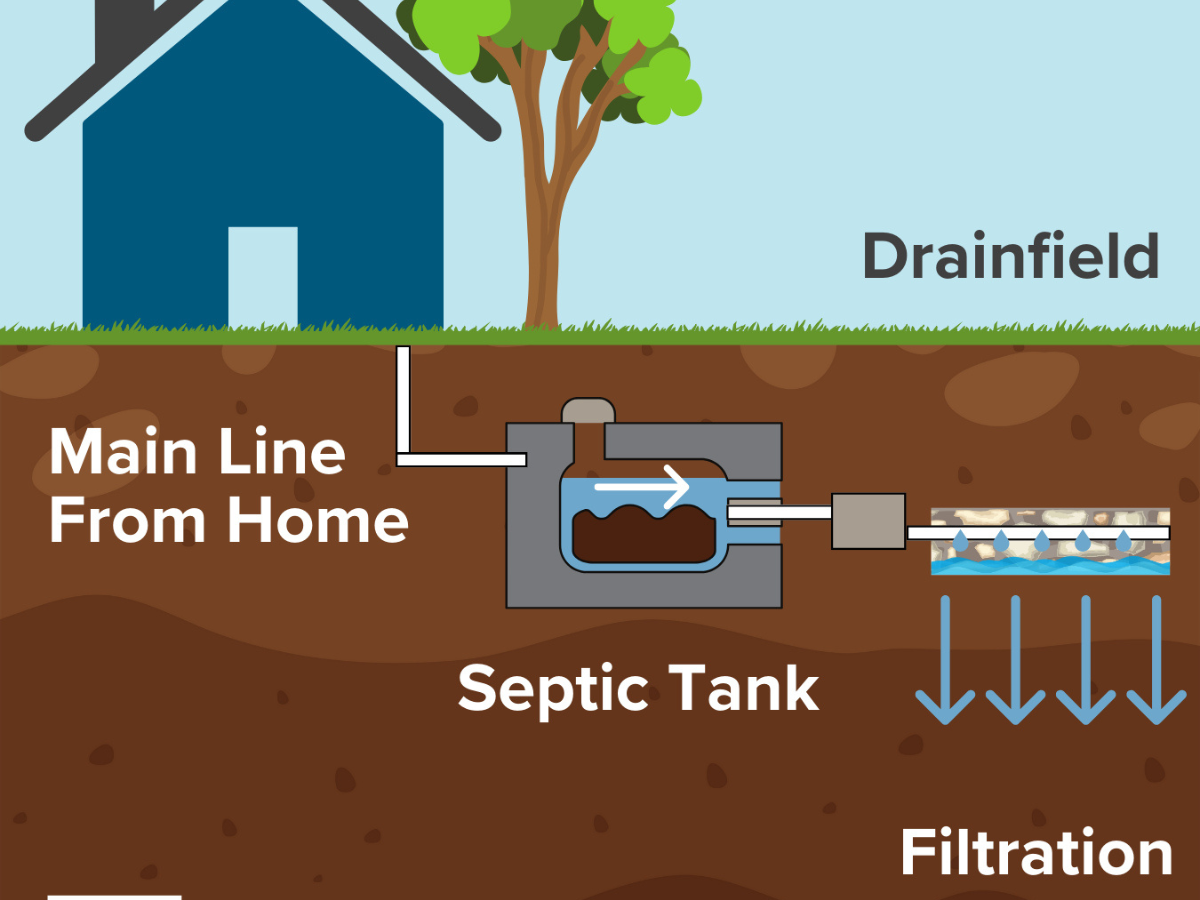
Image: NEIWPCC.org
Meanwhile, back at the septic tank, the solids (or sludge) remain and must be gloriously pumped by a local company (ours plays ice-cream truck music during the process) once every 2 years or so. Some towns or states require scheduled septic maintenance and inspections, so be certain to learn the local rules. When locating the initial placement of your tank, it is important to keep regular pumping in mind because a septic truck’s hose can only reach so far. How far exactly is best answered by a call to your local septic companies. Answers may range from 50-200 feet or more. The leach field location, on the other hand, will be determined by a local sewage enforcement office. Understand that once installed and buried, a leach field should not be disturbed. This includes driving or paving over the top. So if you’re planning to run tractors or other maintenance equipment over the field? Don’t.
An Advanced Septic System differs from a conventional system in how the majority of wastewater contaminants are removed. They are necessary when the soil (or site conditions) don’t permit the water to effectively percolate or filter through the soil. There are a variety of alternative septic systems and myriad factors determine which you can use. Ours is a sand mound system, and its use was mandated by our local Sewage Enforcement Officer after a review of our build site, groundwater locations, and soil tests. This news came with some disappointments: the system–although covered in grass– must sit above the natural ground surface (like a Neolithic burial mound); at $25,000 it added significant expense to our home-building cost; it required us to build a temporary, construction-access road; and it uses a pumping system which occasionally jams due to an interfering pebble or two. But, our state requires an advanced system due to shallow bedrock….and we like clean groundwater. So a sand mound was built.
If you are considering buying land for a future build site? A soil test (called a perc test) is a critical preliminary step to assess whether or not the land will ultimately make a suitable home site and whether it will require a Convential or Advanced Septic System. If the property fails a perc test, hopefully an appropriate Advanced System can be identified by the local sewage authority. And you’ll need to budget for this (it could range anywhere from $15,000-$30,000 or more). It is important to note that a failed perc test can occasionally lead to the inability to obtain a building permit, which is obviously a major problem. So understanding this test and ensuring it is conducted prior to land acquisition is strongly recommended.
Important Septic Does and Don’ts
Don’t flush materials that will not easily decompose. This includes tampons, Kleenex, hair, and “disposable wipes” (which septic pros report have become a serious problem). We ultimately placed signs in our guest bathrooms after too many unsuitable items were flushed away by unknowing friends and family. We also have hair catches hidden under our shower drains to help prevent problems with clogs.
Don’t plant trees with invasive root systems anywhere near your septic system. This includes proximity to the tank, pipes, and drain field. Root systems can dramatically compromise the integrity of one component or the system as a whole.
Don’t use bleach or flush antibiotics down the toilet. These items can interfere with the natural bacteria necessary to decompose waste. Keep this in mind not only when doing laundry but also before reaching for monthly toilet tank bleach drop-ins.
Don’t drive over your drainage field. Don’t plant over it. Don’t pave over it. Just stay away from it.
Do test for “perc before purchase.” Be aware of a property’s allowances and limitations before investing.
Do limit your use of toilet paper. Even safe paper becomes unsafe with excessive use.
Do plant grass over your drain field to prevent erosion and aid in water absorption.
Do keep records of permits and the location of the septic system components on file.
Do work with licensed and local professionals. This is not an area in which to cut corners to save a dime. And no one knows more than your locals about how your soil performs and how local weather patterns will impact installation.
And finally, my favorite piece of actual industry advice: Don’t enter your septic tank. Really, this should go without saying. Not only because the contents and their gases are potentially lethal, but also because you most likely want friends.