
There is a time and a place for gas-powered landscape equipment. But that time and place is never with me personally. I find it heavy, I hate the fumes, and it’s pretty fussy to deal with. Plus? I’m a relatively strong woman, but pulling those starter cords while simultaneously holding down the equipment? I’ll gratefully leave that task to someone else.
Gas-powered engines require some know-how and some maintenance as well. Understanding fuel types? Oils? Lubricants? Maintenance schedules? Flushing tanks in the off-season? Fugetabout it.
I’m now smitten with the ease of battery-powered landscape equipment. I can blow leaves off my front stoop 5 minutes before guests arrive and not smell like I just walked out of a machine shop! Hedge trimmers are light enough that I can trim something tall and still be able to use my arms the following day.
Not all battery-powered equipment is created alike, however. So we’ve done the research for you and compiled a list of those models we love and those models that are receiving the best reviews to date.
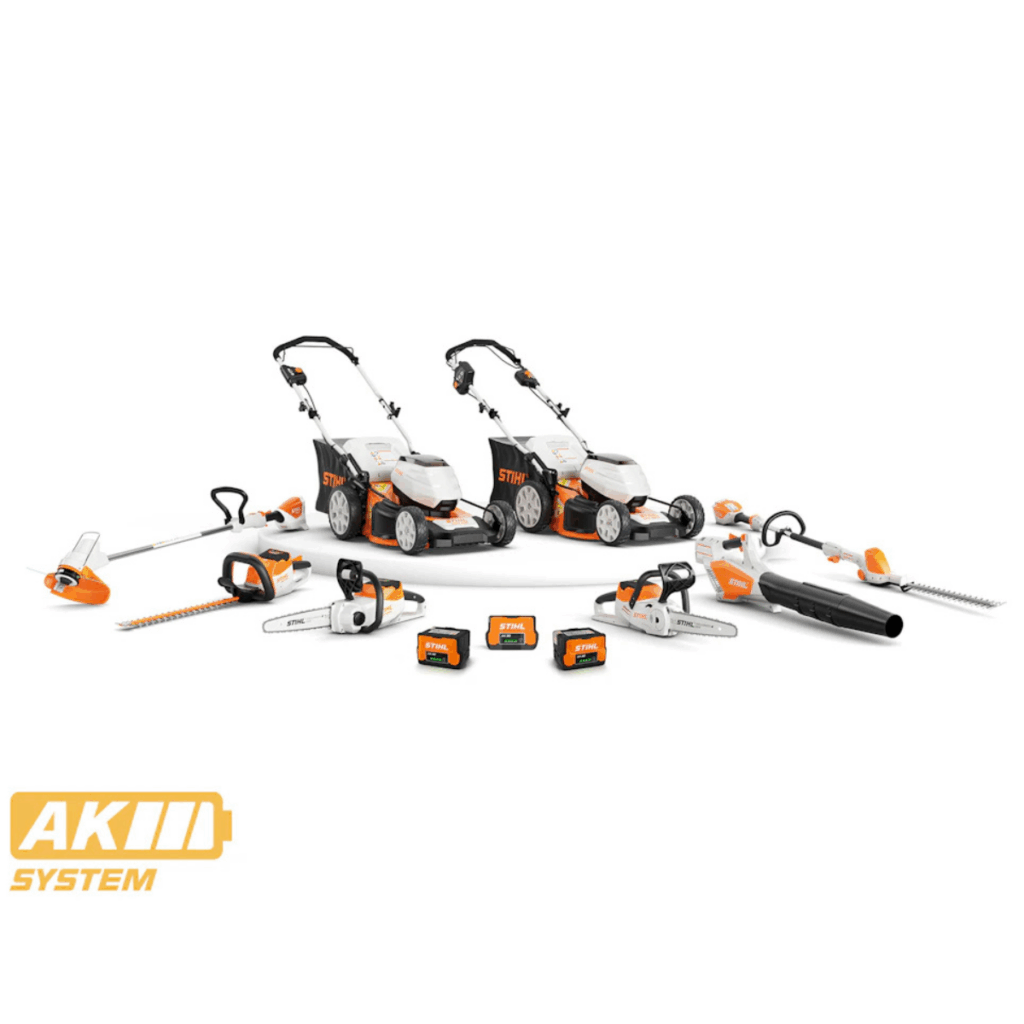
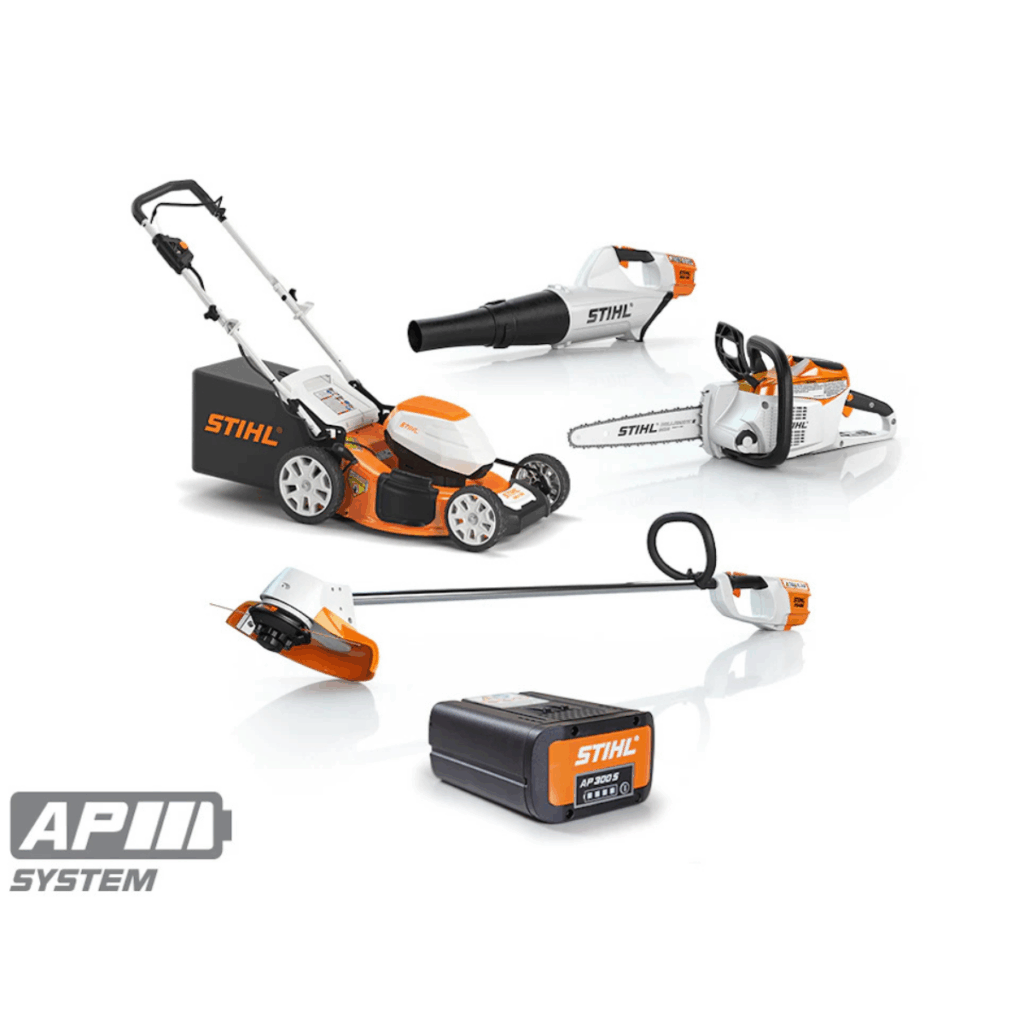
STIHL AK and AP Homeowner Systems
I find the only real challenge with owning battery-powered equipment is the batteries themselves. Many are not interchangeable between tools, even within the same brand. So that can require owning and maintaining a charge on a variety of expensive batteries. Companies are now selling systems of tools that solve that dilemma.
If we were starting over? This is the route we would take, rather than collecting the hodge-podge of equipment and batteries currently cluttering our workshop. And we’d likely stick with STIHL since we’ve had excellent success with their battery-powered equipment to date.
STIHL offers two primary lines of equipment systems. The AK System is marketed to smaller property owners (1 acre or less) and individuals who want to take on occasional landscaping maintenance or projects themselves. The AP System is for larger properties and longer workdays; ideal for those who want to do regular landscape maintenance on their own.
The critical differences? Battery charge cycles (the overall lifespan of the battery), battery runtime per use, overall equipment weight, and variable throttles (the AK System tools run at 100% power or nothing; AP can operate at a range of powers).
You don’t need to purchase every tool in the system all at once. You can phase in as you go. Or simply buy one or two tools and hire a landscaper to do the rest. Whatever you do, the interchangeable batteries are the selling point. And considering batteries are still, ultimately disposable, and range anywhere from roughly $200 to $400 per battery? It’s a pretty compelling selling point.
DeWalt FlexVolt Battery System
While not marketed as a tool system per se, DeWalt offers lawn equipment compatible with their FlexVolt Battery System. These batteries are capable of operating at either 60V for tools that require more power (such as a chainsaw) and they can then be dialed back to 20 V for tools requiring less vroooom (such as a hedge trimmer). Their landscape tools are highly rated and we’ve included reviews of several below. DeWalt’s FlexVolt battery system is also compatible with a growing number of their cordless work tools as well, such as a reciprocating saw and circular saw, should you be longing to expand your upland home’s workshop.

Perhaps you just need to add one or two pieces of equipment to your line-up? Here are the tools we found to be the most consistently highly rated and positively reviewed on the market.
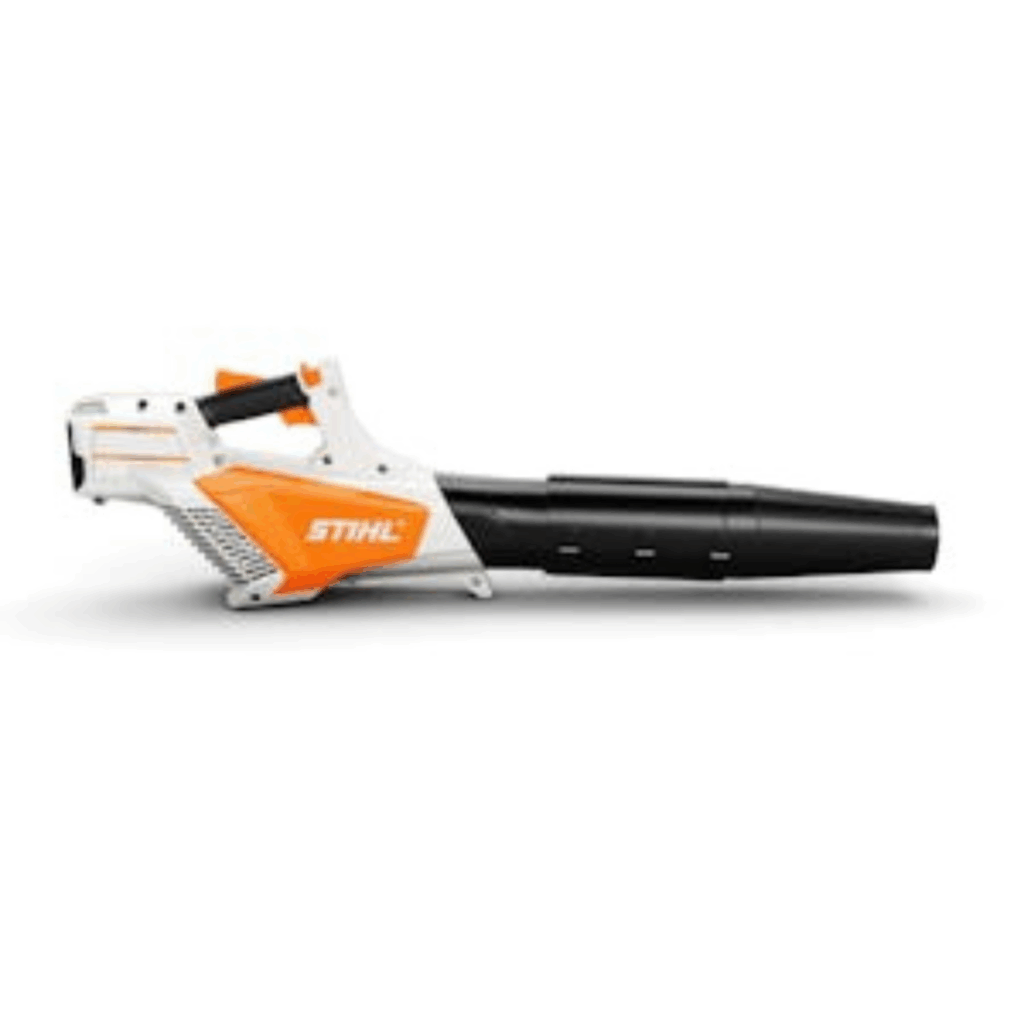
Best Blower: STIHL BGA 57 Battery-powered Blower
We’ve owned this model for a few years and concur with the overwhelmingly positive reviews. While we don’t blow leaves in our yard (we don’t even rake, we simply mulch them with a mower) we do use this to blow off our deck, gravel driveway, patio, and walkways. It is lightweight, powerful, doesn’t emit any fumes, and doesn’t make my hand go numb from the motor’s vibration (IYKYK). AK System-compatible battery and charger included.
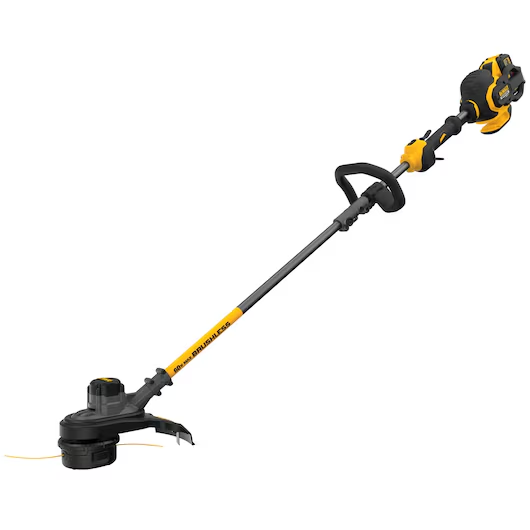
Best String Trimmer: DeWalt 60 V String Trimmer
String trimmers are more commonly known as “weed whackers,” and they are essential for trimming grass around fences, near foundations, and along paths. This model by DeWalt is compatible with a brush cutter attachment, making it more versatile in a rural setting, along fields and woods where it’s necessary to tame dense undergrowth. The motor is also “brushless’ which in simplest terms means it operates more efficiently and with fewer moving parts to worry about maintaining. Battery and charger included.
Best Edger: Greenworks 60 V 8″ Cordless Edger
Full disclosure? I’ve never used an edger and I think our landscape tells this tale. This tool is at the top of my wish list for 2026. And this model ranks highly. A power edger makes quick work of tidying the lines of your mulch beds, walkways, and driveways. If you’ve ever tried to do this work using hand tool, you know what a welcome addition to the lineup this would be. Battery and charger included.
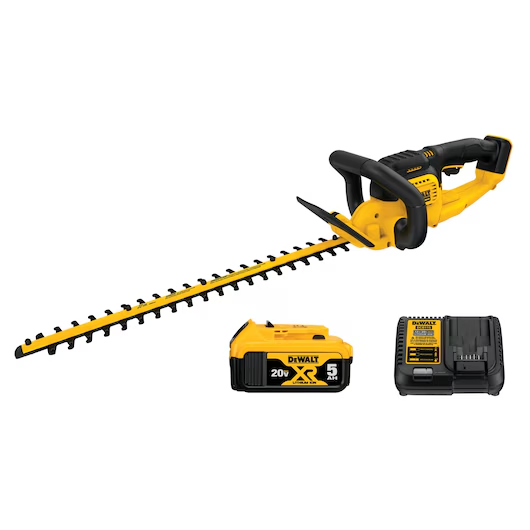
Best Hedge Trimmers: DeWalt 20 Max Hedge Trimmers
Hedge Trimmers are great as long as you can exercise good aesthetic judgment. It’s easy to get carried away with these tools and end up over-trimming your shrubs. Weight is important with hedge trimmers since you’re lifting them rather high to work on taller shrubs. This model weighs 7.5 lbs and even with a 22″ blade for larger hedges, is relatively compact. It can cut through branches up to 3/4″ thick. It is important to keep hedge trimmers sharp or you can easily damage shrubs. DeWalt’s laser-cut, hardened steel blades cut quickly and efficiently, minimizing tears and giving you great precision. Battery and charger included.
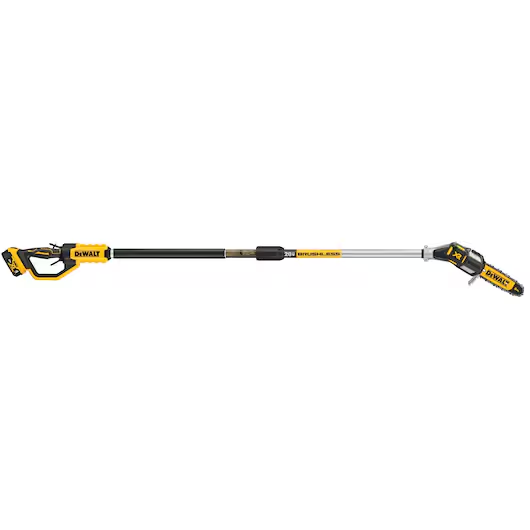
Best Pole Saw: DeWalt 20 V Max XR Cordless Pole Saw Kit
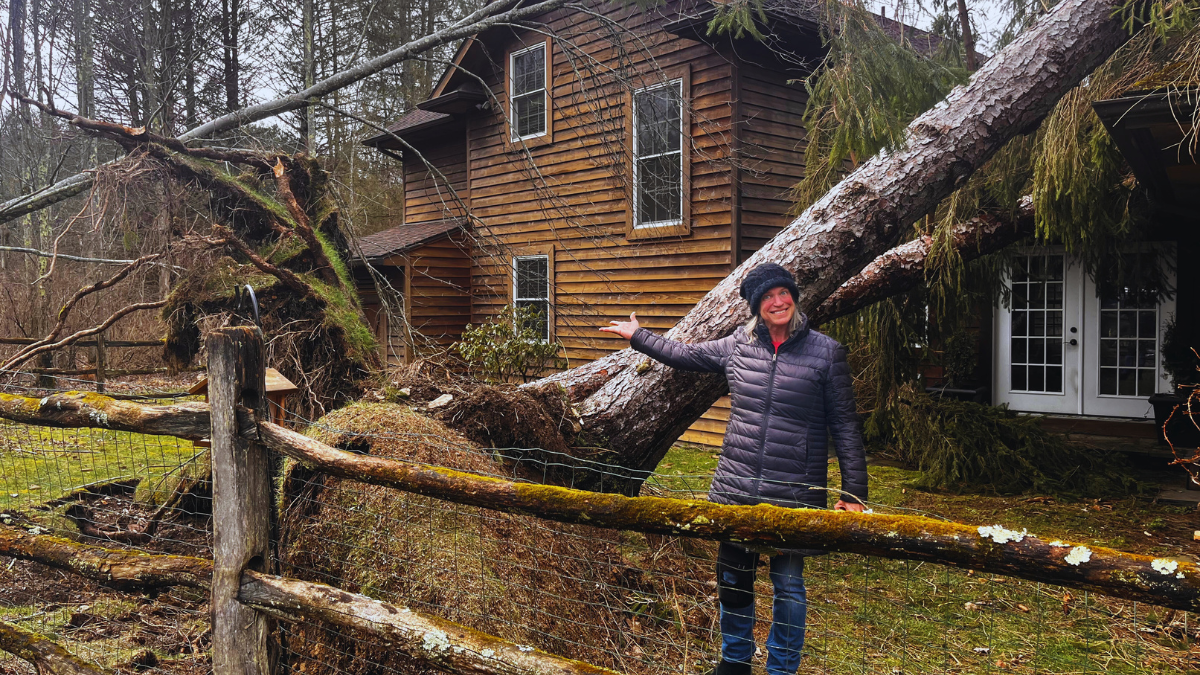
We have a number of windstorms each year at our upland home that wreak havoc on tree branches. It is important that these broken branches be promptly removed, not simply because they look terrible, but because these unclean breaks and tears can compromise the health of the tree by exposing it to disease. It is helpful to have a pole saw on hand to do as much of this trimming from the safety of the ground as possible, rather than balancing tall ladders on unstable ground. DeWalt’s model reaches up to 15′, and has a self-oiling feature for added convenience. Battery and charger included.
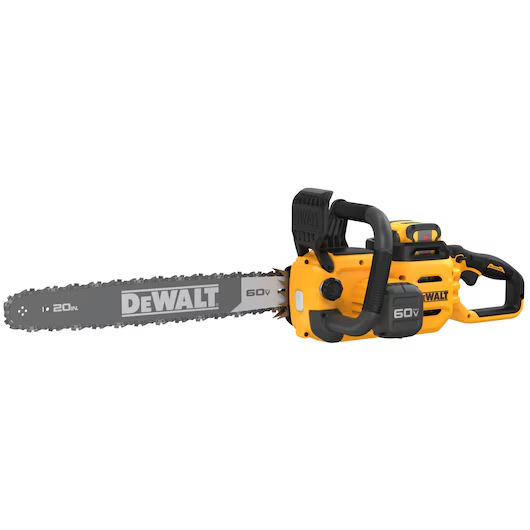
Best Chainsaw: DeWalt DCCS677Z1 Cordless Chainsaw
A chainsaw is an unfortunate necessity on our family’s rural property. I call them “unfortunate” because they are a dangerous piece of equipment that you should honestly never use without proper training. But they’re necessary on remote, upland properties. A tree blocking the road following a storm can quickly turn from a minor annoyance to a substantial problem when tree crews are busy with multiple projects at once. My father dragged his feet on purchasing a battery-powered chainsaw for years under the assumption they wouldn’t yield enough power; and granted, sometimes they can’t simply can’t. Differentiating between those circumstances is an important part of knowing how to properly operate a chainsaw. That said, he absolutely loves his battery saw. This workhorse is lightweight, easy to maintain, and just a bit safer than a gas-powered model. It features tool-free blade chain tensioning (blade chains can loosen after use) and a special knob that helps keep the chain from loosening during use. It’s perfect for smaller trees that are still too unweildy to remove from the road by hand. It is also self-oiling, which is a headache-saver. Battery and charger included
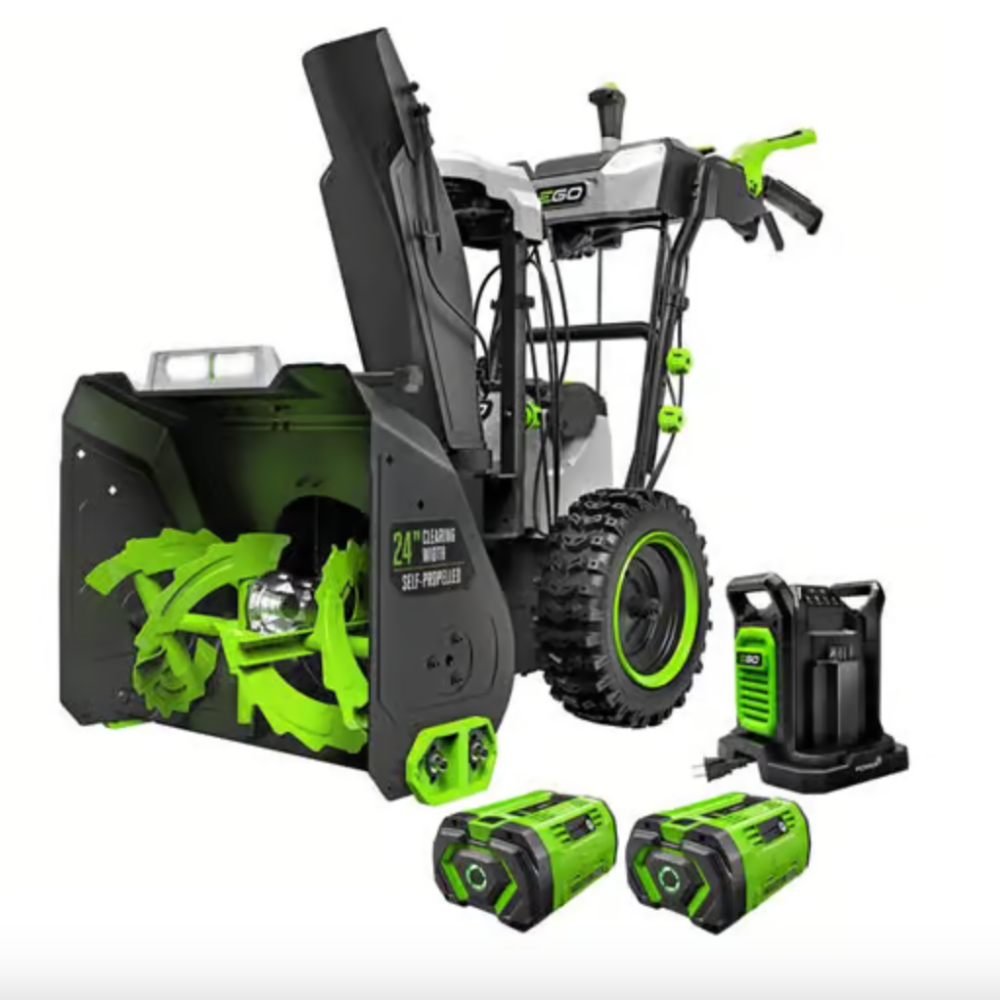
Best Snowblower: Ego Power SNT 2416 24″ Two-stage Snowblower
It’s hard to believe these winter workhorses can be constructed to run on battery power, but the word on this model is that it’s more than capable. Ego’s Power SNT 2416 model (shown below) is what is referred to as a two-stage model (as opposed to a single-stage). The difference is that a single-stage uses an auger to pull in the snow and blow it out of the chute (fine for light snow); a two-stage uses larger augers to pull snow into the center of the machine, and an impeller to eject it up to 50 feet out of the chute. All you really need to know, in short, is that a two-stage has the power to work through heavier and deeper snow (up to 8″). They are also better suited for gravel paths and/or uneven surfaces because the skid shoes (included) are adjustable, allowing the auger to lift and rotate with more ground clearance. It is self-propelled, which is extremely helpful for navigating through heavy snow or up an incline. The chute is adjustable, meaning the snow thrown from its intended path can be directed where you need it to land (as opposed to on a car or a spouse….which I promised to forgive, so I’ll just drop it). Running at top speed, the battery charge will last up to an hour. The 24″ reference in the model name is the width of the intake (or path the blower will carve).