

At our family’s upland home in Pennsylvania, destructive storms seem to be on the rise. And in an area of the country that is heavily forested, the loss of electrical power due to fallen trees, broken limbs, or even foul play by squirrels is a common occurrence. It is not unusual for the power company to take days to restore power. Some areas of our community often wait a week or more. And dependent on the time of year or whether you have access to public water, these outages can quickly turn from an inconvenience to a major problem. Being cold in the dead of winter is not pleasant. Being unable to flush toilets or run water when your well pump loses power is miserable. A burst pipe in an unattended vacation home during a freak winter storm is catastrophic.
Power generators are the answer to these problems and in our experience, have become an essential part of owning a rural home. There are multiple types of residential power generators: portable, inverter, solar, and the big gun—and focus of our review here—standby generators. Also called “whole house generators”, these workhorses can take over virtually seamlessly during a power outage, so you can carry on life as usual without a single moment of inconvenience. They are however, relatively large, can be quite loud, cost a pretty penny, and require a reliable and substantial fuel source. so planning ahead is helpful.
Standby generators are hardwired into your home by an electrician and use a transfer switch that allows them to automatically “transfer” power to the generator as soon as the traditional power source is cut. Similarly, once the system senses power has been restored, it will transfer back to the traditional source and turn off the generator. This is brilliant when power is restored in the middle of the night or when no one is home, saving fuel and general wear and tear on the unit.
A standby generator should have the capacity to power your entire house, if feasible. This will typically require the unit to power roughly 22-26 kW of household demand. If your home is unusually large, there are different options ranging up to 60 kW for commercial-grade generators, but we’re focused here on an average home’s needs. Your electrician will be able to determine if your needs are greater than average and advise you from there.

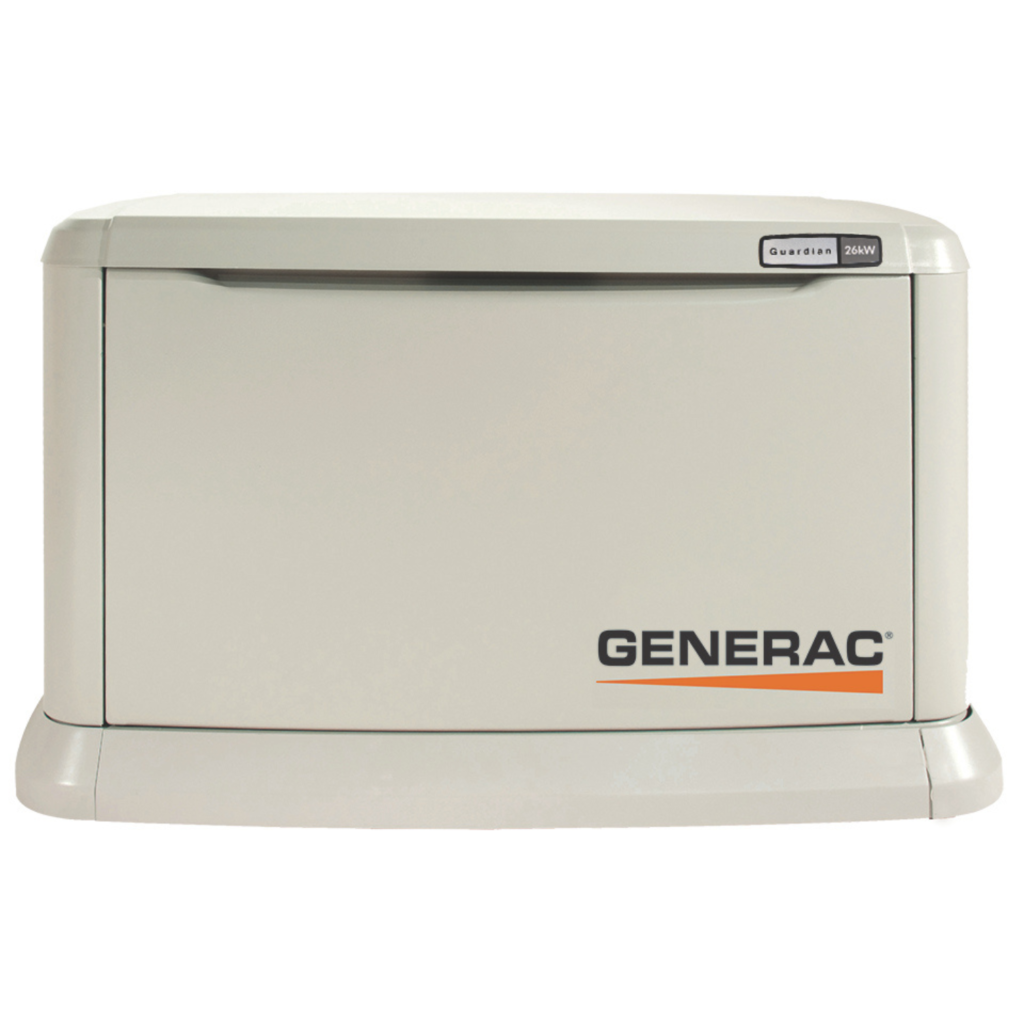
Two of the most trusted names in generators are Kohler and Generac. The former offers a 26 kW standby generator for approximately $7,300 and the latter a 26 kW generator for roughly $7,900. There are multiple models at varying kWs, so you’ll need to work with your electrician to determine what’s adequate for your home. But for planning purposes, this is a good start. Bear in mind, the purchase of the unit is only a portion of the expense. You’ll need to allow for permitting, the purchase of a transfer switch, power supply (such as propane or natural gas), and the largest portion of the expense—labor. Our generator runs on the same natural gas that heats our home, and for that, we are most grateful. That means that we never run out of fuel, even during a prolonged power outage.
Propane is also a popular choice and can be stored in tanks located above or below ground, depending on local regulations. Your propane supplier will know the answer to that question and may even help you secure the necessary permits. If using propane, you’ll want to ensure you keep enough in the tank(s) to get you through a substantial outage. The tanks are also relatively large and, in addition to a sizeable stand-by generator, you’ll need to determine where to locate them in relation to the house.

Another factor you may want to consider is the noise a generator makes. During the damage from the storm pictured above, we were without power for so long, I lost count of the days (this is me desperately fighting back tears on only day one). Generators can be quite loud, and after listening to them roar nonstop for a week, the racket can become a bit grating. So check the decibel levels when purchasing. Generally speaking, anything between 50-60 decibels is considered quiet (like a normal conversation level or the hum of a refrigerator) while 90-100 decibels is noisy (like the noise created by a motorcycle or lawnmower). Ours is quite loud, and while I’m immensely grateful to have it, quiet would be nice too.
Finally, units with wireless monitors are now widely available and should you own a weekend or vacation home, will come in quite handy, especially if you live in an area prone to extreme cold. They can help you monitor fuel levels so that you never run out unexpectedly and risk frozen pipes or worse.